.png?width=125&height=84&name=HUBGEM%20Logo%20-%20smaller%20logo%20(1000%20x%20673).png "HUBGEM Logo - smaller logo (1000 x 673)")
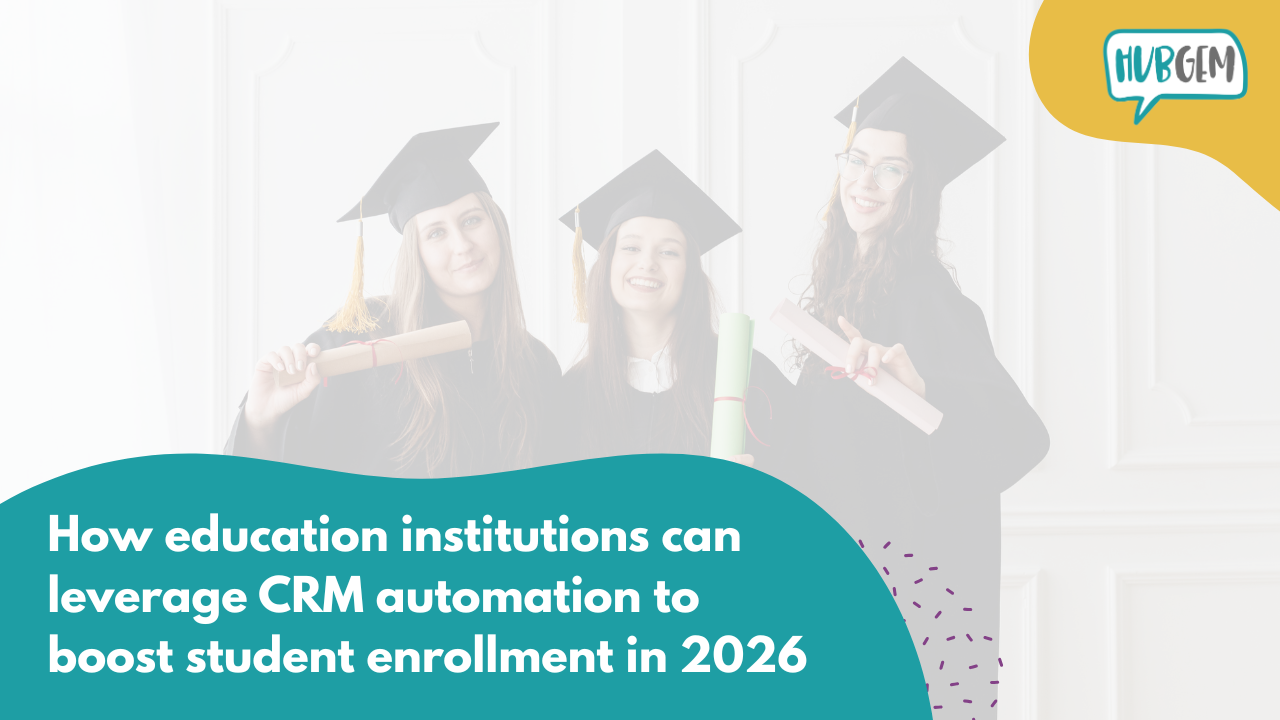
The education landscape is evolving rapidly, and institutions that fail to adapt their enrollment strategies risk falling behind. In 2026, successful schools, colleges, and universities are leveraging Customer Relationship Management (CRM) automation to streamline their admissions processes, nurture prospective students more effectively, and ultimately boost enrollment numbers.
As competition for students intensifies and digital expectations continue to rise, education institutions need sophisticated tools to manage the complex journey from initial enquiry to enrollment. CRM automation offers the solution, enabling institutions to deliver personalised experiences at scale whilst maximising efficiency and improving conversion rates.
Understanding the modern student journey
Today's prospective students interact with educational institutions across multiple touchpoints before making enrollment decisions. They research programmes online, attend virtual open days, download prospectuses, engage with social media content, and communicate through various channels including email, chat, and phone.
This multi-channel approach creates complexity for admissions teams who must track interactions, maintain consistent messaging, and ensure no prospect falls through the cracks. Without proper systems in place, valuable leads can be lost, and the student experience suffers.
CRM automation addresses these challenges by creating a unified view of each prospect's journey, enabling institutions to deliver timely, relevant communications that guide students towards enrollment.
Key benefits of CRM automation for education institutions
Enhanced lead nurturing
CRM automation enables institutions to create sophisticated nurturing sequences that deliver the right content at the right time. For example, when a prospective student downloads a programme brochure, they can automatically receive a series of emails featuring student testimonials, faculty spotlights, and career outcomes specific to their area of interest.
This personalised approach keeps your institution top-of-mind whilst providing valuable information that helps prospects make informed decisions. Research shows that nurtured leads produce, on average, a 20% increase in sales opportunities compared to non-nurtured leads.
Improved response times
Speed matters in education marketing. Studies indicate that institutions that respond to inquiries within five minutes are 100 times more likely to connect with prospects than those that wait 30 minutes or longer.
CRM automation ensures immediate acknowledgment of inquiries through automated responses, whilst simultaneously alerting admissions staff to high-priority leads. This dual approach maintains engagement whilst ensuring human follow-up happens promptly.
Better resource allocation
Not all leads are created equal. CRM automation helps institutions identify and prioritise high-quality prospects through lead scoring mechanisms that consider factors such as programme interest, engagement level, geographic location, and demographic information.
This intelligence enables admissions teams to focus their time and energy on prospects most likely to enroll, improving conversion rates and maximising return on marketing investment.
Ready to transform your institution's enrollment process? Chat to our sales team to discover how CRM automation can boost your student recruitment efforts.
Essential CRM automation strategies for 2026
1. Intelligent lead capture and segmentation
Modern CRM systems can automatically capture leads from multiple sources including website forms, social media, events, and referral programmes. More importantly, they can instantly segment these leads based on predefined criteria such as:
- Programme of interest
- Study level (undergraduate, postgraduate, professional development)
- Geographic location
- Intended start date
- Funding requirements
- Previous educational background
This segmentation enables highly targeted communication strategies that resonate with specific prospect groups, improving engagement and conversion rates.
2. Personalised email marketing campaigns
Email remains one of the most effective channels for education marketing, with an average ROI of £42 for every £1 spent. CRM automation takes email marketing to the next level by enabling institutions to create dynamic, personalised campaigns that adapt based on recipient behaviour.
For example, prospects who engage with engineering programme content can automatically receive emails featuring:
- Engineering faculty profiles and research highlights
- Industry partnership announcements
- Graduate employment statistics
- Virtual lab tours and facility showcases
- Alumni success stories from engineering graduates
3. Automated event management
Open days, information sessions, and campus tours are crucial touchpoints in the student journey. CRM automation can streamline event management by:
- Automatically sending event invitations to relevant prospect segments
- Managing registrations and sending confirmation details
- Delivering pre-event information and preparation materials
- Following up with attendees and non-attendees with appropriate next steps
- Tracking event ROI and identifying most effective event types
4. Application process automation
The application process can be a significant barrier to enrollment if not properly managed. CRM automation can guide prospects through each stage, providing:
- Automated reminders for incomplete applications
- Status updates throughout the review process
- Personalised guidance on required documentation
- Automatic escalation of applications requiring urgent attention
- Post-decision communications tailored to acceptance or rejection outcomes
Measuring success: Key metrics for education CRM automation
To maximise the impact of CRM automation, institutions must track relevant metrics that indicate performance and identify areas for improvement:
Conversion metrics
- Enquiry-to-application conversion rate: Percentage of initial inquiries that result in completed applications
- Application-to-enrollment conversion rate: Percentage of applications that result in actual enrollment
- Overall enquiry-to-enrollment conversion rate: End-to-end conversion from first contact to enrollment
Engagement metrics
- Email open and click-through rates: Indicating content relevance and audience engagement
- Website behaviour: Time spent on key pages, content downloads, and form completions
- Event attendance rates: Participation in virtual and in-person events
Efficiency metrics
- Response time: Average time between enquiry and first response
- Cost per lead: Marketing spend divided by number of qualified leads generated
- Cost per enrollment: Total marketing and admissions costs divided by number of enrollments
Looking to implement comprehensive CRM automation for your institution? Chat to our sales team to learn how we can help you achieve measurable improvements in enrollment outcomes.
Overcoming common implementation challenges
Data quality and integration
Many institutions struggle with fragmented data across multiple systems. Successful CRM automation requires clean, integrated data that provides a complete view of each prospect's journey. This often involves:
- Auditing existing data sources and quality
- Establishing data governance policies
- Integrating CRM with existing student information systems
- Training staff on data entry best practices
Staff training and adoption
Technology is only as effective as the people using it. Successful CRM automation implementation requires comprehensive training programmes that help staff understand not just how to use the system, but why automation benefits both the institution and prospective students.
Maintaining personal touch
Whilst automation improves efficiency, education remains a relationship-driven sector. The most successful institutions use automation to enhance rather than replace human interactions, ensuring that technology supports meaningful connections between staff and prospects.
Future trends in education CRM automation
As we progress through 2026, several trends are shaping the future of CRM automation in education:
Artificial intelligence and predictive analytics
AI-powered CRM systems can predict which prospects are most likely to enroll based on historical data and behaviour patterns. This enables institutions to allocate resources more effectively and intervene proactively when prospects show signs of disengagement.
Omnichannel communication
Modern prospects expect seamless communication across all channels. Advanced CRM automation platforms integrate email, SMS, social media, chat, and phone communications into unified workflows that maintain context regardless of channel.
Enhanced personalisation
Dynamic content capabilities enable institutions to create highly personalised experiences that adapt in real-time based on prospect behaviour, preferences, and characteristics.
Ready to future-proof your institution's enrollment strategy? Chat to our sales team to explore how cutting-edge CRM automation can transform your student recruitment efforts.
Discover how HubGem helps schools, colleges, and universities boost enrollment with HubSpot.
FAQs
How long does it take to implement CRM automation for an education institution?
Implementation timelines vary depending on institutional size and complexity, but most education institutions can expect a 3-6 month implementation period. This includes data migration, system configuration, staff training, and workflow optimisation. Working with experienced education sector specialists can significantly reduce implementation time and ensure best practices are followed from the start.
What's the typical ROI of CRM automation for education institutions?
Education institutions typically see ROI within 12-18 months of implementation. Common benefits include 20-30% improvement in conversion rates, 40-50% reduction in manual administrative tasks, and 25-35% increase in lead quality. The exact ROI depends on current processes, institutional size, and implementation quality.
Can CRM automation work for smaller education institutions with limited budgets?
Absolutely. Modern CRM platforms offer scalable solutions that can grow with your institution. Many systems offer education-specific pricing and functionality that makes automation accessible even for smaller schools and colleges. The key is starting with core automation workflows and expanding capabilities over time.
How does CRM automation comply with data protection regulations like GDPR?
Reputable CRM platforms include built-in compliance features for GDPR and other data protection regulations. This includes consent management, data retention policies, and audit trails. However, institutions must ensure their automation workflows and data handling practices align with regulatory requirements and institutional policies.
What's the difference between marketing automation and CRM automation in education?
Marketing automation focuses primarily on lead generation and nurturing activities, whilst CRM automation encompasses the entire student lifecycle from initial enquiry through enrollment and beyond. For education institutions, integrated platforms that combine both capabilities provide the most comprehensive solution for managing student relationships effectively.

.png)